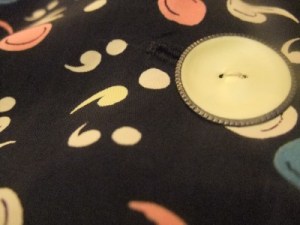
A close up of this great rayon print and the button detail are the eye-catchers
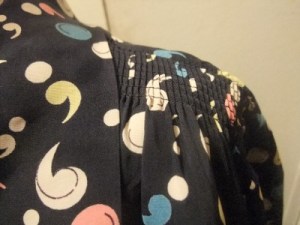
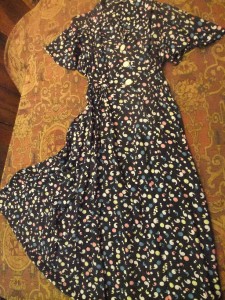
I was scanning through my eBay search emails today and came across a listing for this 1940’s rayon print dress that showed a detailed photograph of the fabric and a button, rather than a photograph of the entire dress. Some sellers choose to do this, but don’t always capture the detail in a way that is compelling, the way the a photograph of the entire dress would. This listing, however, caught my eye because of this fantastic punctuation-themed print and the butter-colored buttons with metallic trim. On closer inspection, there were even more details in the dress, like smocking at the shoulders and what looks like smocking on the bodice just above the skirt. This seller, mir.a, is smart because just looking at the dress by itself, at a distance, it appears nondescript on its own and somewhat shapeless without a model – but showing off the dress’s fantastic details is enough for me to give this dress a further look (to discover it’s not in my size). Laid flat, measurements are 38 waist, 43 bust, free hips.
The smocking detail at the shoulder.The details become lost because the dress is a puddle on the ground - the smocking can't cinch a shoulder or waist without a shoulder or waist to wear it!
I’ve highlighted the adorable reproductions made by Etsy seller Jitterbuggin in the past, but I think she’s really hit her stride with these new (since my last post) matching 1940’s jumper and blouse sets in blue and green. I’m linking to the jumpers, as the blouse must be purchased separately, and all are available in multiple sizes.
Everything about the sets is just fantastic, the pocket details on the jumpers, the line of the skirts, the fabric choices for both the jumpers and the blouses (especially the airplanes!), and the contrast collar and sleeve bands on the green blouse. On top of that, Jitterbuggin shows you how to wear it by styling her models to the hilt, with period hair, hosiery, shoes, red lips, hair flowers, and bakelite accessories. Very Groovie Movie!
I’m excited to announce that the Yehoodi staff has invited me to contribute featured content to the Yehoodi website. This is my first article for Yehoodi, which I am also publishing here on Lindy Shopper for your use and enjoyment.
Following the Why I Wear Vintage post, Evan Philips requested an entry on how to take care of your vintage clothing and I am happy to oblige. Taking care of any wardrobe requires some maintenance if you want to keep it looking nice. Vintage clothing sometimes requires a little more effort to keep it looking fresh, but if you are careful in your choices for maintaining your vintage garments, you can enjoy them longer and with less worry.
For this article, I consulted with the all-knowing Movie Diva, Laura Boyes, who has experience working with the costume collection at the North Carolina Museum of History. I’ll share my observations from experience, but Laura will be providing the pro tips!
CLEANING
So you bought an article of vintage clothing, wore it to a dance, sweated in it for three hours, and now it’s a little ripe. You’d like to know how to clean it, but there’s no convenient garment tag telling you if it’s dry clean only, hand wash, or wash cold/tumble dry low. Think about what you have in your closet that is in the same fabric – what instructions for care are on that garment? Now, consider that this garment is vintage and, as a precautionary measure, what method of cleaning would be a bit more delicate than that, just in case?
Identifying the fabric is very important. Unless a garment is made of cotton, I will be sending it to the dry cleaners, and even the cotton garments sometimes get sent there if I’m particularly squeamish about hand washing the garment or putting it into my washing machine on the hand wash setting. If I am washing a garment myself, I always hang it up or lay it flat to dry, rather than putting it in the dryer. Laura recommends washing your vintage clothing in a gentle detergent, such as Orvus WA Paste, “a synthetic anionic detergent with a neutral pH which will remove most common dirt and stains.” You may be able to find this at farm supply stores, as it is used to shampoo show horses.
Finding a dry cleaner you trust is worth its weight in gold. You want to find someone with years of experience – don’t cheap out on this just because the $1.99 cleaner is near your house. Do some research, make calls to find out how long they have been in business, if they have worked with vintage and antique clothing, and be willing to sign your life away for them to clean it because most of them won’t want the liability of having to deal with you if the garment deteriorates. Usually if a place has been in business for a long time, they will have a good reputation and will also have older clientele who may have some of these older fabrics and older items that need some extra care when cleaned. I feel truly lucky to have found an amazing dry cleaner in Chapel Hill, NC, Plaza Dry Cleaners. Not only are they the oldest dry cleaners in town, one of their cleaners has taken classes in clothing preservation at the National Archives in Washington, D.C. I’ve been using their services for 6 years now and they have yet to ruin one of my vintage items; in most cases, the garments come out looking even better, with fewer stains and a fresher look to the fabric.
When you take a garment into the dry cleaners, you will need to make a few declarations about the garment so that they know that you are educated about the garment, so they have the information they need to make an informed decision about cleaning the garment, and so they are on notice that this is a special care item. If you know the decade, tell them how old the garment is, note in advance the flaws you are aware of (spots, holes, etc.), indicate whether or not you want them to try to get the spot out, and tell them what you believe to be the correct fabric. If you don’t know what kind of fabric you have, someone there will be able to identify it.
They may not want to clean the item for fear that the process will do something to the fabric or that something on the garment will be harmed in the process. I will say that this situation is pretty rare and limited to uncommon garments, like a 1920’s velvet dress with a jeweled piece or a 1930’s rain coat. In this situation I usually ask if there is some other way I could clean the garment myself or ask if hand-washing would damage the garment. If I really want the item cleaned and do not care if the garment could be harmed in the process, they will usually have me sign a waiver stating that I have been informed of the potential consequences and waive their liability.
Unless you are wearing vintage every day, the cost for your vintage dry cleaning shouldn’t be prohibitive. I might have two items per month that I take out for cleaning.
In those extremely rare cases where the garment can’t be cleaned, don’t wear those garments dancing or in places where you will sweat a lot. Hang them up after you wear them and let them air out for a few days before storing them again.
MENDING
Almost everything can be fixed. Many times, if you look closely at a vintage garment, you can find places where it has already been fixed or altered by the previous owner. Earlier generations mended holes in garments, rather than discarding them, because resources and clothing were more limited. I find that vintage garments tend to take a mending much easier than newer garments because of the way the garments were constructed.
Order of operations number one is to find a tailor who has either worked with vintage clothing in the past, works with fine fabrics, and/or has been sewing for longer than you’ve been alive. I once made the mistake of handing over a silk 1940’s suit in a strawberry print for my mom to reinforce the seams on the sleeves and, having never worked with silks, made the mistake of putting the suit under the needle of her Singer sewing machine on the regular setting. She might as well have put it under the knife, because the silk shredded into a million pieces. I should have told her to hand sew the sleeves, but this is a lesson in assumptions – don’t assume that every tailor will know how to fix your garment. Ask lots of questions and err on the side of caution.
I found my vintage tailor through a locally owned fabric store that sells fine fabrics and other fabrics for clothing. The had a list of people they recommend for people who want custom made items, with a description of each person’s areas of expertise. After talking with the ladies in the store about what I was looking for, they were able to make recommendations as to which tailor(s) would be best for the job.
You may have noticed that article of clothing purchased new that you wear frequently for a period of several years may begin to fall into disrepair, or even fall into disrepair after one season if not well made – remember this when you are cursing that newly discovered hole in your 1940’s pants or dress. The tendency for modern clothing is to get rid of it – throw it away or donate it to a thrift shop, because there will always be something to buy new. The approach to wearing vintage clothing is entirely different and is rooted in that era’s sensibilities. There may be more vintage clothing, but the supply is not replenishing, so repairing a vintage garment becomes an act of preservation.
To preserve your vintage clothing, you sometimes have to think outside of the box, or ask your tailor to be creative. If a button falls off, there’s no little plastic baggie with an extra button for you to sew on and finding a matching button is impossible. So, you find new button and use this opportunity to make the garment even better – something as simple as buttons can change the entire look of a garment, and you can update the garment with new buttons or find vintage buttons on Etsy, eBay, or a few other online resources. I had a 1940’s dress with terrible buttons on it and just switching out the buttons took the dress from matronly to swing-worthy with just a few stitches.
What if there’s a giant hole? Your tailor may be able to harvest some fabric from a hem or inside part of the garment to create a seamless patch, or come up with another way to cover the hole.
What if the seam split? Get your tailor to sew it up and perhaps reinforce it.
You get the idea. 🙂
STORING
Enemy target: eradicated
Moth balls smell like old people. Vintage clothing was once worn by old people and stored by old people. Why is vintage clothing still around? I’m not going to credit moth balls with saving all vintage clothing from moths, but I am going to credit it with maintaining a good portion of my wardrobe and the portion of my wardrobe inherited from others who used moth balls to keep their clothing free from holes. I initially shunned moth balls because of my mother’s over-use of the moth ball when I was growing up – she would toss a whole box into a closet and stuff them in drawers, until every time you tried to wear something that hadn’t been just laundered, you’d come out of the house smelling like a great-aunt. When I went to college I stayed far away from moth balls until I pulled my favorite red wool dress out of the closet to wear at Christmas and discovered two large moth holes in the shoulder; a deeper dig into my wardrobe and I discovered even more casualties. In tears on the floor of my bedroom, I vowed that the moths would never claim another victim from my closet.
Moderation is key. I don’t need moth balls to protect everything, so I have a moth ball section in my closet. I use a hanging moth ball basket I got at the grocery store, which initially came with moth cakes, but I can also fill with moth balls. The moth cakes/balls dissipate over time, so you do have to refill them from time to time. The hanging basket allows me to group my most vulnerable clothing (wools and other natural fibers) in one section of my closet and hang the basket in the middle of that group. It has limited the extreme moth ball smell to a smaller group of garments, which I then air out a few days before I plan to wear them.
Let’s talk about hangers – next to moths, wire hangers are your clothing’s worst enemy. Wire hangers are too sparse to hold clothing without almost penetrating it and, over time, the wires begin to rust and that rust is corrosive to clothing. I’ve seen countless casualties created by wire hangers, where the rust stains have eaten holes in the garment and you can see exactly how that garment was hung on the wire hanger. Please invest in plastic, wooden, or fabric covered hangers for your clothing. Plastic and wooden hangers are good for everyday clothing. If you have a more delicate item, such as mesh, chiffon, or other sheer fabric, pick up a few padded, fabric covered hangers.
If an items is particularly fragile or the weight of the garment is too much for the straps or shoulder of the garment, consider storing the garment folded in a drawer, with ample space and nothing stored on top of it (i.e. don’t cram it into an already full drawer). According to Laura, it’s also a good idea to have some acid free tissue paper on hand to line drawers, separate layers, stuff hats, or pad hangers, as needed.
If you have clothing that is from the 1920’s or older, Laura states that these garments should be stored flat. “If you buy one of these boxes (and keep it under your bed, or on a closet shelf) and layer in between with acid free tissue, it will preserve your dresses from the stress of hanging. You would probably want to store items this way that you wear only occasionally.”
The rest is common sense: Don’t leave things where your pets have access to them; men, hang up your ties, don’t leave them on the floor; don’t store things where they might get soiled; etc.
If you have any further questions about this topic, please feel free to ask! We want to keep these articles of vintage clothing alive and wearable as long as possible.
It’s been a while since I checked on Heyday!, my favorite UK retailer of heavenly high waisted trousers, but I see that they have been busy. They have expanded their line of women’s and men’s clothing and have some pretty impressive and hard-to-find pieces at not unreasonable prices. Men can pick up some more casual style jackets, like the gab jacket or the Hollywood jacket, or some elegant 1940’s trousers. Women who are looking for separates will find several styles of adorable reproduction blouses, 1940’s style suits, dresses that are great for dances and work, as well as those famous trousers that make everyone’s bum look like a million bucks.
Here are my favorites from the website:
How sharp are these! Get your Gene Kelly on in the Anzac trousers, available in 9 colorsYou just can't go wrong with these swing trousers - available in 14 colorsFleur wrap dress, available in 6 printsHollywood jacket, an alternative to the traditional blazerOlivia blouse - stinkin' adorable, in 11 colorsWant this suit!
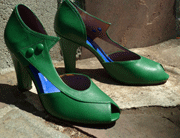
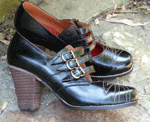
When it rains, it pours, and it’s pouring gorgeous shoes this week. Remix has launched two new styles: the Eva, a Picasso-esque work of art for your feet in green and black; and Amelia, a late 1920’s/early 1930’s Mary Jane heel with three straps in black. The Amelia is cute and sturdy, but the Eva is to die for…they should be paired with that villainess dress I found and wreak havoc on a small city with their sheer awesomeness.
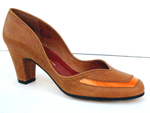
Ava shoe
The Ava shoe is on sale, a versatile pump that could work for dance floor and for work, originally $190.00 and now on sale for $98.00. This shoe comes in camel with orange inset, brown with dark brown inset, gray with black inset, and white with kiwi inset.
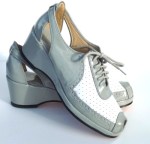
Finally, there’s a limited run of the spectator wedge in a gray patent and white combo, priced at $112.00. Gray is such a great neutral, these look fantastic!
One of my shopping challenges this year was issued by NashPhilly dancer/instructor/DJ/blogger, Breanna Perry, to find her a vintage red dress with a peplum. This is a fairly tall order, given that most of the vintage dresses I come across with a peplum are black, not a color. I found one older dress (was it ’80’s does ’40’s?) dress that fit the bill on eBay, but the auction was lost in the end.
There have been a few modern dresses with peplums popping up on ModCloth, but today’s dress really fits the bill. The Red-y For Anything Dress looks like a fabulous contender, with a lovely rounded neckline, nipped waistband, cheerful peplum, and a clean-lined pencil skirt. This dress is super hot! My only complaint is that, in the item description, ModCloth refers to the peplum as a “dainty ruffle” – in my opinion, there’s nothing dainty about something that changes the entire silhouette of the dress; let’s call it what it is.
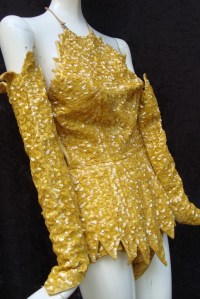
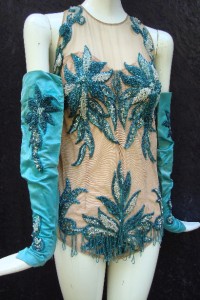
I can’t help but be fascinated when these vintage dance performance items show up on eBay. I posted some 1920’s tap shoes earlier, but these auctions really take the cake! eBay seller monicasvintagefashions has four vintage dance costumes worthy of a Busby Berkeley style dance number, which is pretty rare, considering I had trouble even finding reference photographs while researching costumes for The Carolina Fascinators. These are just fantastic, especially the ones from the 1920’s…paging Sharon Davis and Sister Kate…
Beaded 1920's Art Deco costume, with a nod to Egyptian revivalA beautiful sequined 1920's costume with butterfly wingsA three piece suit in gold sequins with Art Deco-style cutouts around the neck, hem, and top of the glovesA lovely blue 1950's costume with beading on the bodice and gloves
I took this photograph at the movie theater tonight, from a giant banner for the movie “The Help,” which will be in theaters tomorrow. I am almost 95% certain that these shoes are the white Aris Allen 1940’s peep toe oxfords. Can anyone verify this? I suppose it caught me off-guard – you expect to see, for example, Remix reproduction 1920’s shoes in a 1920’s movie, but not necessarily 1940’s repro shoes in a 1960’s movie. Surprises where you least expect it. 🙂
Of course, after I save up and decide to buy them, they go out of stock...but now I get a second chance!
This post was written by Lindy Shopper.
I’m jumping out of my chair with excitement because the Balboas are back! At least for a limited run, that is – the Balboas in the ivory/parchment combo are available, along with the brown combo and black. If you’ve been on the fence about one of these pairs of shoes, get off the fence right now, sell an organ, take out a loan, and get them while they are in stock because LS has on good information that these shoes will no longer run in their current design.
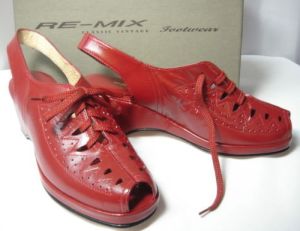
In other glorious Remix news, the men’s captoe oxford is also available in a new color, a soft brown leather. The popular Anita shoe will be made in metallics – muted gold and silver – which I love because metallics go with so many things and make your footwork shine! Also available in a new color is the Strider, a 1930’s/40’s oxford, which breaks away from muted tones and now comes in a cheerful purple.
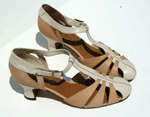
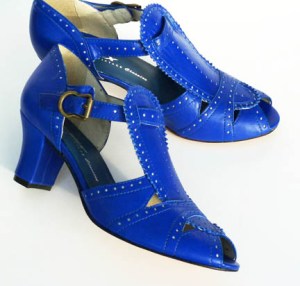
I don’t know if I had time to mention this style when they launched, but Remix’s Emily shoe is a lovely brogued t-strap shoe that is simply a knockout. Available in ivory and a bright blue they are calling “Ultramar Blue.” Using my Google skills (rather, looking for a photograph to post), I also found this shoe available in brown at Shoostore.com.
I am a big fan of 1940’s dresses with sequin appliques, but re-creating this look has been almost impossible due to lack of resources for good, ready-made appliques. Most of the appliques I have seen in modern fabric stores tend to be either matronly or childish. It’s hard to place sequin appliques in context during my lifetime (Dallas? Golden Girls?), but people in the 1940’s did some beautiful things with appliques and used them liberally to create embellishment on beautiful dresses, which otherwise might appear plain.
In searching for silver stars for a headpiece, I came across Sequin Appliques, a website devoted to selling…well, sequin appliques. There are so many things here – styles, shapes, sizes, colors – my mind is racing as to what I might do with some of these appliques. The obvious thing would be to buy a plain dress from somewhere and gussy it up by tacking on an applique, on the lapel, bodice, or skirt. I could also see some interesting fascinators made from some of these pieces, or simply pin one in your hair. Maybe shoe clips…or sew them on to your sueded Keds. 🙂
Here are some of my favorites from the Sequin Appliques web site:
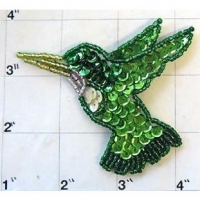
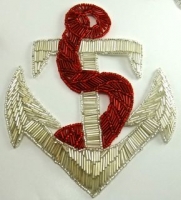
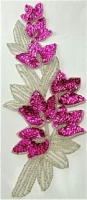
I WILL find a dress for this appliqueLarge butterfly appliqueClassic bow appliqueAn elaborate monochromatic floral beaded appliqueSilver beaded star with crystalsPlaying card setBeaded anchor - ahoy!Floral motif
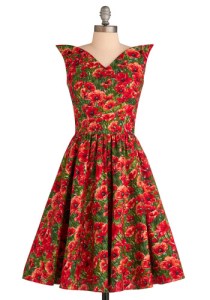
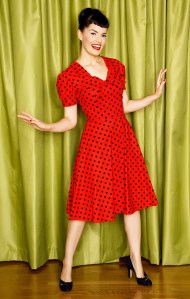
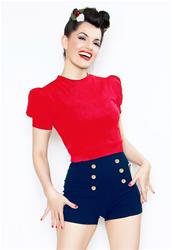
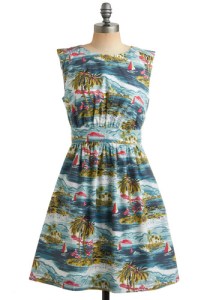
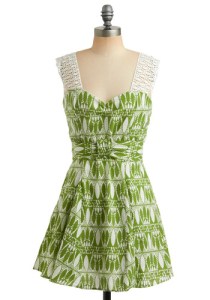
If you’ve been to just about any website that sells rockabilly clothing, you’ve probably seen Bernie Dexter, a lovely model who looks like Bettie Page reincarnated and makes every dress she models look flawless. I was trolling Mod Cloth the other day (who isn’t? every day? 😉 ) and happened upon a wonderful green and white dress with a distinctly 1940’s shape, which happened to be designed by Bernie Dexter. Until then I hadn’t put a face with a name, but I was delighted to discover that Ms. Dexter has a whole line of 1940’s and 1950’s-inspired clothing, in addition to her illustrious modeling career. Unfortunately, you can’t order her clothing directly from her website, but through a number of other online and brick-and-mortar retailers (including stores based in the USA, Germany, Australia, France, Canada, England, and Austria) you can piece together the wonderful garments from her collection. Here are my favorites:
Wizard of Awesome dress available on ModCloth.com - poppies, anyone?Landscape dress available at UniqueVintage.comHigh waisted pencil skirt, available at UniqueVintage.comOh, the gingham! There's a dress, a romper, and a bikini in this fabric, available at UniqueVintage.comSweetheart neckline dress, available at UniqueVintage.comSailor shorts, available at bearflagrepublic.com
Two interesting specimens popped up in my eBay searches this week. First, herringbone knickers/plus fours and a matching jacket, which the seller is dating 1930’s or 1940’s, but someone who knows menswear better than me might have a better handle on their decade of origin. In any case, knickers are awesome and here’s a whole suit for your day on the links, night on the dance floor, or the next tweed ride – 39 jacket and 31 waist.
Second, ignore the uncomfortable looking dude in the picture and focus on this blue Depression-era wool suit that the seller dates between 1933 and 1935 due to the National Recovery Administration (or NRA…not to be confused with that other NRA) label inside. This suit is exactly my husband’s size and he won’t have anything to do with it because it’s blue, so I’m beside myself with disappointment…but maybe it will fit one of you? 42 jacket, 32 pants, starting bid at $19.99.
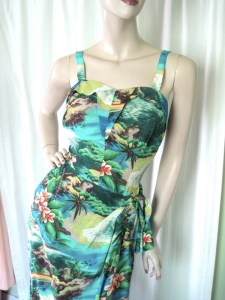
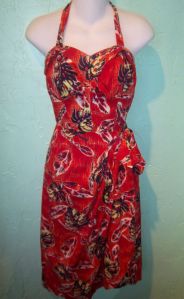
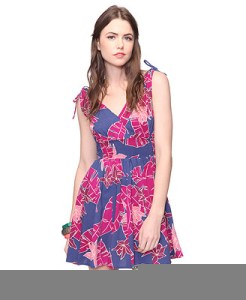
Anyone else wishing they were in Honolulu instead of at their office desk on a Monday morning? I ran across a few adorable tropical dresses, both new and vintage, I thought were worth sharing – enjoy!
ModCloth's Too Much Fun Dress in ParadiseModCloth dress to-be-named - you can submit your idea for a name and possibly win this dress!eBay 1940's Hawaiian dress, comes with matching boleroAnother lovely 1940's-1950's sarong-inspired number on eBayForever 21 Hibiscus Surplice Dress
EBay seller 4 Birds Vintage may have hit the motherload: “This is just the one of a 50-pair shoe collection ~ mostly new old stock from a family shoe store ~ that will be available within the next week. Most shoes are from the years 1890 – 1940 and include original boxes and store price tags. Brands include Star, Poll Parrot, Florsheim, and more.” I’ll definitely be checking back to see what this seller adds to his/her eBay page!
This pair of white leather oxfords is the first of this collection listed and they are in fantastic condition. You’ll have to get a ruler out to determine the size, but the seller says, “These shoes measure 10″ in length on the inside, 3 1/2″ wide on the bottom, with a 1″ heel.” Buy It Now is at $125, a bit more than your Aris Allens, but definitely less than a pair of Remix oxfords.



















 Lindy Shopper